
Still in the game
PLAYING EVERY MATCH LIKE IT’S YOUR LAST.
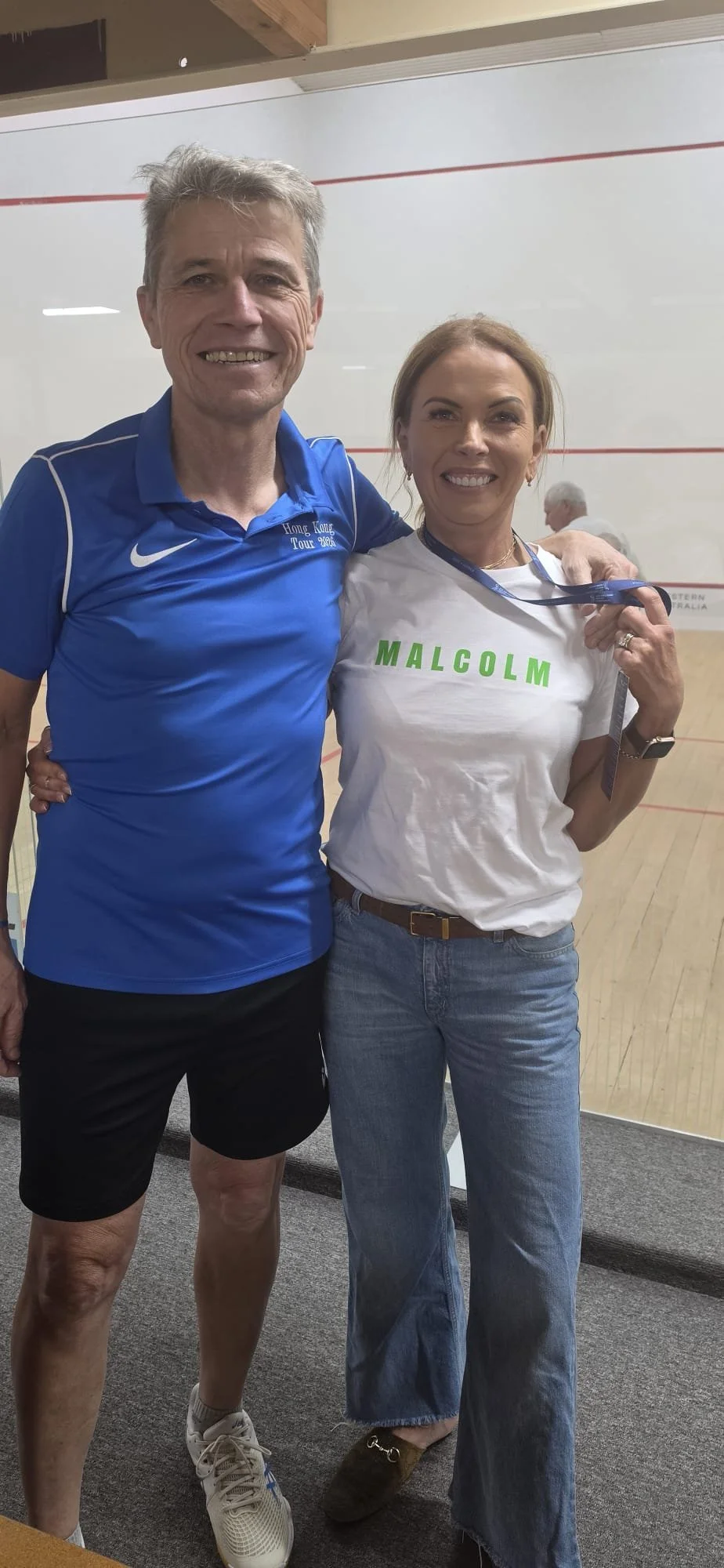
Photo - Personal library
Cancer can change the body. It can change the plan. It can change almost everything we hold dear. But sometimes, if we're lucky, it doesn’t get to decide what happens next.
A few weeks ago, Bayan, Hugo and I stood beside a squash court in Perth, Australia, watching a 66-year-old man chase a tiny black ball around a glass box.
I had never watched a squash competition in my life and, as I sat in the stands, phone in hand, taking a frantic crash course in the rules, the first game ended before I worked out what was going on. I shouted, clapped my hands, held my breath, and willed him on, behaving as though I had followed professional squash my entire life. I hadn't. We had travelled to Perth for Malcolm.
Malcolm McClarty and Bayan have been best friends since High School, and we were there to honour a promise and a commitment Bayan had made to him. Because if cancer has taught us anything, it is that these are the moments that count. This is what you do for friends. This is how you show up in life.
To anyone in the Australian squash world, Malcolm needs very little introduction. He has spent a lifetime playing and coaching squash. He won gold at the 2009 World Masters Games, became Victorian Masters Champion in 2011 and represented Australia, competing internationally for decades. In 2023, already in his sixties, he won the WSF Masters Tour event in Hong Kong. He has also coached generations of players while continuing to compete well into his sixties.
Squash is not simply something Malcolm does. It is deeply embedded in his DNA. He is funny. Irreverent. Competitive. Stubborn. Occasionally, actually, frequently, he wears a self-confidence that borders on a rather large ego, but underneath it is something slightly different: an almost unquestioning belief in his ability to win. He has an opinion on most things, a story for everything and, at 66 years old, still seems to believe that a squash court is a perfectly reasonable place to behave like a 25-year-old.
What you couldn't see, watching him charge around that court in Perth, was that Malcolm has Stage IV prostate cancer and somehow those two things, the man charging around the squash court and the man living with Stage IV cancer, have learnt to coexist. Perhaps I noticed it because I understand it so deeply. Not his cancer. Not his prognosis. Not his journey. Those belong entirely to him.
But I understand something about waking up in a body that has betrayed you and then, slowly and rather tentatively, learning to trust it again. I understand what it feels like when cancer enters your life and suddenly divides time into two very distinct chapters.
Before. And after.
Before, we make plans as though the future belongs to us. Afterwards, we make them knowing that it never really did. And strangely, somewhere inside that terrifying realisation, there can be the most enormous freedom. Perhaps that was precisely the point.
Malcolm’s story began with a pain in his right hip. His body had spent decades being pushed, stretched and tested through squash, so naturally he assumed it was another sporting injury. Except this one didn't get better. The pain began waking him at night and, somewhere underneath all the rational explanations we give ourselves when we desperately don't want something to be wrong, Malcolm knew something wasn't right.
At almost the same time, life delivered another blow. His younger sister was diagnosed with Stage IV pancreatic cancer. She died five months later. And while Malcolm watched his sister go through her cancer journey, he was carrying unexplained pain inside his own body. Sometimes life asks far too much of one human heart. This was surely one of them.
One evening, Malcolm mentioned the pain to someone he coached. That man was Professor Niall Tebbutt, a medical oncologist. Niall listened and, instead of accepting Malcolm's sporting-injury explanation, told him he needed to get checked.
A PSA blood test followed. And then came the conveyor belt so many of us in this strange cancer club know intimately. Tests...scans...waiting...more scans...biopsies...
Medical language you have never needed to understand before suddenly becomes the most important vocabulary of your life. And then there is the unbearable space between one appointment and the next, when everyone seems to know something about your body except you. Medicine moves through its necessary processes while your imagination gallops approximately 6,000 miles ahead.
Eventually Malcolm had his answer. Aggressive Stage IV prostate cancer. It had already spread beyond his prostate and into his pelvic bones. Malcolm remembers wanting one thing from the doctors around him. The truth. Not softened. Not dressed up and not delivered in careful half-sentences. “Just tell me what I'm dealing with.” I understood that immediately. Cancer takes so much control away from you that sometimes knowledge, even frightening knowledge, becomes its own form of power. Malcolm needed to know. And then he needed a plan.
What followed was treatment. Medication to suppress the testosterone feeding the cancer. Radiotherapy. More medication. More scans. More blood tests. And a body Malcolm had trusted for most of his life suddenly became a body he barely recognised. This was a man who had spent decades on a squash court and suddenly no longer had the strength to play.
One day, standing in his apartment, he opened the fridge, took out a bottle of water and discovered that he didn't have the strength to unscrew the lid. That detail stayed with me. Cancer is so multifaceted, and we talk about treatment in neat clinical language. Fatigue. Muscle loss. Hormone suppression. Side effects. But sometimes the reality is much simpler. One day you are an athlete. The next you cannot open a bottle of water without confronting the terrifying reality that the strength you have always taken for granted has disappeared.
Malcolm says there were moments when he questioned whether treatment was worth it. Quality of life mattered enormously to him. He had watched his sister lose hers. He wasn't interested only in being alive. He really wanted to live
There is a difference.
And I think anyone who has sat opposite an oncologist and discussed treatments that may save your life while simultaneously changing it understands that difference completely. His doctors put together a treatment plan: Hormone therapy, newer-generation medication and radiotherapy and then began that strange contradiction of cancer treatment. Allowing people to make you feel considerably worse in the hope that eventually they will make you better.
This is the madness in it. But we do it. We turn up. We put our arm out. We swallow the tablets. We climb onto the machines. Sit on the chairs. We sign the forms. We allow strangers to inject, scan, prod, irradiate and investigate parts of our bodies we previously considered rather private. Dignity becomes surprisingly negotiable. And we keep going. Because underneath all of it is one tiny, magnificent word.
Hope.
Malcolm's body responded. His PSA fell dramatically. Eventually it became undetectable. But perhaps what fascinates me most is what Malcolm did while his body was trying to find its way back. He kept showing up. He kept working. He kept coaching. He kept travelling. He stayed around the game he loved, even when he didn't have the strength to play it as he once had. And, perhaps most painfully for a man as fiercely competitive as Malcolm, he watched players he had previously beaten comfortably begin beating him.
Malcolm, being Malcolm, didn't accept this newfound hierarchy with quite the grace one might expect of a gentleman in his sixties. He warned them. And slowly, he did come back. His body began to recover. He started playing again. Not spectacularly. Not all at once. He started where he could. Then he did a little more. And a little more. Until somewhere along the way, an idea that might once have seemed completely impossible began to take shape.
The World Masters Squash Championships. Perth, 2026. Why not? So Malcolm trained. He worked. He rebuilt. And eventually he entered.
Which is how Bayan, Hugo and I found ourselves in Perth, watching a 66-year-old man with Stage IV prostate cancer walk onto a squash court at the World Masters Championships.
And suddenly, this wasn't really a cancer story anymore. It was a story about life.
As I watched him play, I kept thinking about that bottle of water. The hand that couldn't twist off a plastic lid was now gripping a squash racquet. The legs that had lost so much strength were chasing a ball around the court. The body that had frightened him, weakened him, carried cancer and endured treatment was carrying him again. There is something miraculous about that. We spend so much of our lives criticising our bodies. Too fat. Too thin. Too old. Too wrinkled. Too scarred. And then sometimes those same imperfect bodies carry us through something we were quite certain would break us. Mine certainly doesn't look the way it did before cancer. There are scars where there weren't scars. It carried me here. And watching Malcolm, I felt that sense of gratitude all over again.
During our conversation, Malcolm said something almost casually. “I'm playing every match like it's my last match.” I knew immediately that I would remember it. There is sadness in those words. Of course there is. Like me, Malcolm knows his cancer hasn't magically disappeared from his story. There will be blood tests. There will be numbers. There will be scans. When you live with cancer, uncertainty becomes an unwanted travelling companion. You don't invite it in. You certainly don't like it. But eventually you learn to let it sit quietly in the back seat while you get on with driving. I like to think that is what Malcolm is doing. He isn't playing every match like it's his last because he is waiting to die. He is doing it because he's learned something most of us spend our entire lives avoiding. None of us knows how many matches we have left. Cancer simply had the audacity to tell him.
I need to say something here. Because those of us who have survived cancer have to be careful with stories like ours. I believe enormously in the power of the mind. I believe in visualisation and manifestation. I believe in hope. I believe in miracles, universal power and giving ourselves something to work towards. I believe that the human body is capable of things that sometimes seem impossible.
But I do not believe cancer can be defeated only by positive thinking. I don't believe somebody dies because they didn't fight hard enough. And I absolutely don't believe that those of us fortunate enough to still be here somehow wanted life more than the people we have lost. Cancer doesn't work like that. Biology matters. Medicine matters. Science matters. Timing matters. Access to treatment matters.
And sometimes, despite extraordinary medicine, extraordinary courage and an extraordinary will to live, cancer still wins. Malcolm knows that. I know that. We have both lost people who desperately wanted to stay. They did not fail.
So this isn't a story about beating cancer with your mind. It is about something slightly different. It is about what the mind can sometimes do after cancer has tried to redraw the boundaries of your life. It is about having something to reach for. Something to train for. Something to believe might still be possible. Perhaps hope isn't always believing that everything will be all right. Perhaps sometimes hope is simply deciding that, while we are waiting to find out, we are going to live.
Malcolm originally thought he would keep his cancer relatively private. Get on with it. Get on with life. But then something happened. Men heard his story. Some went and got themselves checked. And he began to understand there might be another reason to tell it. “If it saves one person, get it out there.”
So, Malcolm, this is my gift to you and to every man who reads this blog because the pain in his hip wasn't simply a squash injury. Because being incredibly fit did not make him immune to cancer. Because by the time Malcolm was diagnosed, his disease was already Stage IV. And because somewhere, a man reading this has been ignoring something in his own body. Please don't. Listen. Get checked. Sometimes knowing early changes everything.
But there is another reason I'm telling Malcolm's story. It is the reason we went to Perth. We wanted to see Malcolm play. Bayan wanted to stand beside the friend he has known since childhood and honour a promise he had made. And perhaps, without realising it then, I needed to see it too. It is a reminder that while I am here, I am allowed to live as though I am here. To make plans. To dream. To work towards something. To use this battered, scarred, miraculous body. To love the people around me ferociously. To laugh. To travel. To say yes. To occasionally say absolutely not. To stop saving things for someday. To only drink the very best champagne. Because someday is a terribly unreliable place to store your life. To choose my moments, choose my friends, and choose what fills my time. To write my book, to volunteer, to campaign. Or to just wake up one morning, make coffee and realise that for the first ten minutes of the day you forgot you ever had cancer. Those moments matter. They are little pieces of proof.
And watching Malcolm McClarty step onto that squash court in Perth was one of mine. So spectacularly, stubbornly alive. And perhaps that is the miracle. Not pretending cancer never happened. Not denying the fear. Not believing we can control everything with our thoughts. But refusing to let the worst thing that happened to us become the only thing that defines us.
There is life after cancer. Sometimes a messy life. Sometimes life with blood tests every few months and an oncology and scan appointment sitting quietly in the calendar. But life. A BIG, ridiculous, beautiful life. Because none of us, cancer or no cancer, were ever promised tomorrow. We all need to play each match as if it’s our last.
Not because we’re dying, but because we’re still here.
September is Prostate Cancer Awareness Month. If Malcolm's story has made you think about your own health, please don’t ignore that thought. Get checked. Ask the question. Make the appointment.
UK: Prostate Cancer UK 0800 074 8383
Australia: Prostate Cancer Foundation of Australia 1800 22 00 99
South Africa: Prostate Cancer Foundation of South Africa 084 283 3982
Sometimes one conversation really can change a life.